
Revolutionize HVAC Monitoring and Energy Efficiency
Begin your journey toward home Artificial Intelligence driven HVAC monitoring and management
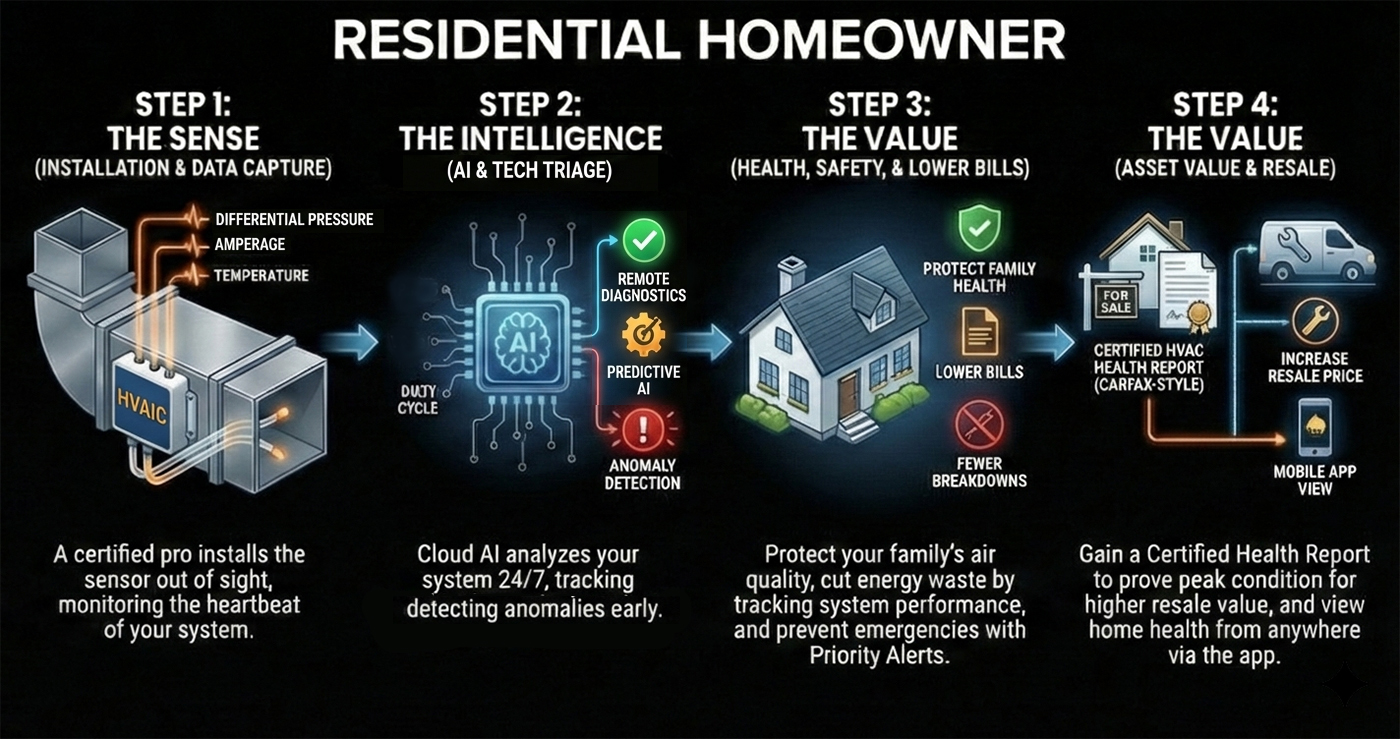
AI processing with HVAIC is a journey. AI processing for any type of application requires historical data for that application. Residential HVAC performance and energy usage analysis is no different. Since energy usage, HVAC equipment and duct design, and home owner thermostat settings are unique, so to is AI processing for each home unique.
HVAIC begins the journey by collecting a myriad of data points typically many times each day for each season of the year. Data captured is directly from inside your HVAC equipment, as well as external from the weather outside and the environment related to your HVAC air handler.
Initially, your system data is analyzed to identify potential upcoming problems, actual problems and performance anomalies. When sufficient data is captured over time, it may then be fully AI processed for your individual home’s needs. The goal is to use AI to continually evaluate the daily dependencies on outdoor temperatures, HVAC operation and more. The result will be energy savings and more comfortable living.
Transform Your Environment with Smart Monitoring
Total Cost of Operation Analysis
- HVAIC monitors your HVAC’s air and in-house system.
- HVAIC measures the air pressure difference between the inlet side and outlet side of the air filter and air flow velocity. These provide an accurate assessment of the filter’s condition.
- Using a filter beyond its limits will force the fan to work harder to push the same amount of air through the system. This can increase the risk of an expensive hardware failure.
- An email and/or text alert is sent to the owner when data indicates an excessively dirty filter.
HVAC Ambient & In-Duct Air Temperatures
- Which temperatures are saved to the cloud?
- In-Duct air before AND after heated or cooled.
- Changes can identify loss of refrigerant or other compressor or related problems
- Outdoor temperature at the time of in-duct measurement, and the forecasated highs and lows for that day.
- The ambient temperature at the HVAC air handler, such as an attic or basement.
- In-Duct air before AND after heated or cooled.
- The most important indicator of a current or future problem with an HVAC system is a continual shift in the temperature of its output air.
- Long term records of the relationship between the various temperatures provides valuable insights into the degradation of HVAC performance, and AI processing for energy saving actions or recommendations.
In-Duct Air Flow Rate
Air Flow Rate monitoring is standard for commercial buildings, and optional for residential housing.
- Probes monitor Cubic Feet/Minute (CFM) air flow inside the duct.
- Using typical flow rates based on HVAC tonnage, or the owner’s specific HVAC unit, HVAIC compares expected flows to actual flow.
- Flow too low can lead to too cold or frozen evaporator coils.
- Flow too fast could lead reduce the ability to dehumidify air, higher blower electricity usage and a noisier system.
Energy Consumption
- HVAIC measures the amount of AC electrical current being used by your air handler. This provides relative data of total HVAC energy consumption by season and the temperature ranges.
- After sufficient historical data is obtained by HVAIC over each day of each season, AI analysis would be able to predict maintenance needs and provide insights into how best to set thermostats for energy reduction.
- Future plans for HVAIC include integration with one or more thermostat brands to automously adjust thermostats to “comfort zone” temperatures preferred by the home owners.
HVAC Run-Time & Energy
- In addition to energy, pressure, current and temperature, the run-time of the HVAC (the duty cycle) is stored with each data capture.
- Current and run-time do not provide KiloWatts of energy use, but relative energy use for each duty cycle. kW calculations require the voltage draw of each HVAC component. Each HVAC has uniqure voltage needs and are not available to HVAIC.
- Since the entire HVAC system never changes, its relative performance from day-to-day is what HVAIC tracks. Knowing the kW is not relevant to saving energy. Duty cycles are what determine the kW, thus HVAIC’s tracking highs, lows and average values represent whether your energy costs go up or down.
Heat Pumps
- Heat pumps become less energy efficient below about 40F.
- When it cannot maintain the set thermostat temperature, auxilary heating coils (AUX) active. A Google AI search shows that this can result in a 50% or higher energy usage.
- HVAIC’s monitoring of current can detect the higher current draw and thus track and report the times of use for AUX activation and its duration.
- An alert or report can be sent to the homeowner. The homeowner could then lower the thermostat setting at the times shown for AUX use to reduce the frequency and duration of its activation.
Outside Air Temperature
- Outside air temperature determines inside air temperature changes.
- Outdoor wireless thermometers are unreliable. Too often they are placed in areas where sun, heat loss from the home or heat from the outdoor HVAC unit influences the measured temperature.
- HVAIC records a weather service temerature for the home’s Zip Code whenever HVAIC sends duct air temperature to our cloud.
- Upcoming HVAC demand can be anticipated by the forecasted high and low temperatures of each day. As stated in the Energy Consumption tab, with sufficient historical data AI could use the forecasts to optimize HVAC functions to reduce the energy impact related to outdoor air temperature changes.
Key Features of Our IoT Monitoring System
Real-Time HVAC Temperature Output Monitoring
Continuously track and store HVAC air handler output temperatures to ensure consistent comfort and monitor for HVAC performance degradation. Current and forecasted outdoor temperatures, and ambient temperature at the air handler are also captured.
Air Filter Cleanliness Alerts
Do you forget to check air filters?Our proprietary differential pressure sensor monitors air pressure on both sides of your air filter. Excessive pressure on the inlet side resultes in instant text/email notifications that the air filter needs attention. HVAIC assures optimal air quality and energy efficiency.
Seasonal Impact on Energy Consumption
Monitor HVAC power usage to track seasonal trends and the impact of heating and cooling on energy consumption. identify savings opportunities related to air filters, thermostat settings and possible fan or other hardware issues.
Begin Your HVAIC Monitoring Experience
Step 1: Have your HVAC service company install HVAIC sensors and connect to your WiFi.
Step 2: Submit your account setup form to Varitex.
Step 3: Enjoy peace of mind knowing that your HVAC system is operating at peak performance & economy.
Increase Your Home's Value
Homes with a strong record of HVAC optimal performance & maintenance is of great value to home buyers, and an incentive to purchase your home at a higher price rather than others.
Contact us today for a personalized consultation and discover how we can help you achieve superior air quality, energy efficiency and added home value.

Dealer and manufacturer representation territories are available.
Future Enhancements
Varitex is actively working with technology partners to expand the capabilities of your HVAIC platform.
- Integration with smart thermostats, such as NEST, Ecobee and others.
- Integration with other smart home appliances or commercial systems.
- AI processing of your HVAC system’s historical data to provide:
- Predictive maintenance requirements or potential system failures.
- Energy savings opportunities.
- Autonomous control of thermostats, dehumidifiers, hot water heaters and more.
- Connectivity to HomeKit, Smart Home and other connected platforms.
