
The Ultimate Service Platform
Industrial Level Monitoring & Analysis for Commercial & Residential Buildings
Revolutionize HVAC Monitoring and Energy Efficiency
Begin your journey toward data driven HVAC monitoring and management

Experience Smarter Comfort with HVAIC
Every building is unique—and HVAIC’s data analytics understands that. By learning from your home or facility’s real-world data, HVAIC delivers customized performance and lasting efficiency.
How HVAIC Works:
- Operational Data Collection: Gathers data from your HVAC equipment and outdoor environment throughout every season when your system is operating.
- Smart Analysis: Detects early signs of issues and finds hidden performance inefficiencies.
- Adaptive Learning: The system refines itself over time, tailoring operation to your building’s layout, usage habits, and climate.
- Benefits: Analysis to assist with lowering energy costs, fewer HVAC problems, and a consistent level of comfort year-round.
HVAIC doesn’t just monitor your system—it learns it, helps you to optimize it, and provides insights so that your system performs most efficiently and economically.

Transform Your Environment with Smart Monitoring
Total Cost of Operation Analysis
- HVAIC monitors your HVAC’s air and hardware.
- HVAIC measures the air pressure difference between the inlet side and outlet side of the air filter and the air flow velocity. These provide an accurate assessment of the filter’s condition and room air balancing.
- Using a filter beyond its limits will force the fan to work harder to push the same amount of air through the system. This can increase the risk of an expensive hardware failure.
- An email and/or text alert is sent to the owner when data indicates an excessively dirty filter or changes to air flow to rooms.
HVAC Ambient & In-Duct Air Temperatures
- Which temperatures are saved to the cloud? In-Duct air before AND after heated or cooled.
- Changes can identify loss of refrigerant or other compressor or related problems.
- Outdoor temperature at the time of in-duct measurement, and the forecasated highs and lows for that day.
- The ambient temperature at the HVAC air handler, such as on the roof for commercial or attic or basement for a home.
- The most important indicator of a current or future problem with an HVAC system is a continual upward or downward shift in the temperature of its output air.
- Long term records of the relationship between the various temperatures provides valuable insights into the degradation of HVAC performance, and historical data processing for energy saving actions or recommendations.
In-Duct Air Flow Rate
Air Flow Rate monitoring is standard for commercial buildings, and optional for residential housing.
- Probes monitor Cubic Feet/Minute (CFM) air flow inside the duct.
- Using typical flow rates based on HVAC tonnage, or the owner’s specific HVAC unit, HVAIC compares expected flows to actual flow.
- Flow too low can lead to too cold or frozen evaporator coils.
- Flow too fast could reduce the ability to dehumidify air, higher blower electricity usage and a noisier system.
Energy Consumption
- HVAIC measures the amount of AC electrical current being used by your air handler. This provides relative data of total HVAC energy consumption by season and the temperature ranges.
- As historical data is obtained by HVAIC over each day of each season, analysis will increasingly be able to predict maintenance needs and provide insights into how best to set thermostats for energy reduction.
- Future plans for HVAIC include integration with one or more thermostat brands to automously adjust thermostats to “comfort zone” temperatures preferred by the business and home owners.
HVAC Run-Time & Energy
- In addition to energy, pressure, current and temperature, the run-time of the HVAC (the duty cycle) is stored with each data capture.
- Because the overall HVAC system configuration remains constant, HVAIC focuses on tracking its relative performance over time. Knowing the exact kilowatt (kW) cost for your location isn’t necessary to identify opportunities for savings—reducing energy use naturally lowers costs. Since duty cycles determine total kW consumption, HVAIC’s monitoring of high, low, and average values indicates whether your energy expenses are trending up or down.
Heat Pumps
- Heat pumps become less energy efficient below about 40F.
- When it cannot maintain the set thermostat temperature, auxilary heating coils (AUX) active. A Google AI search shows that this can result in a 50% or higher energy usage.
- HVAIC’s monitoring of current can detect the higher current draw and thus track and report the times of use for AUX activation and its duration.
- An alert or report can be sent to the homeowner. The homeowner could then lower the thermostat setting at the times shown for AUX use to reduce the frequency and duration of its activation.
Outside Air Temperature
- Outside air temperature determines inside air temperature changes.
- Outdoor wireless thermometers are unreliable. Too often they are placed in areas where sun, heat loss from the home or heat from the outdoor HVAC unit influences the measured temperature.
- HVAIC records a weather service temerature for the home’s Zip Code whenever HVAIC sends duct air temperature to our cloud.
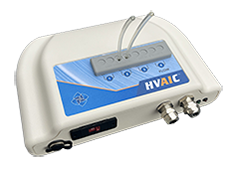
Build Your System
HVAIC
Core System
$799
- Filter Condition: Ultra-Sensitive Differential Pressure Sensor with Auto Ranging
- Energy Consumption: 20A or 100A Air Handler Current Sensor
- Heat/Cooling Performance: In-Duct Temperature Before and After Condenser Coil
- Local Environment Impact: Room Temperature at the Air Handler
- Predict System Usage: Zip Code Outside Air Temperature
Optional Sensors
Contact Us For System Review- Air Velocity Sensor
- UVC Lamp Energy Sensor
- Individual Room Air Temp Sensors
HVAC Contractor Installation is Not Included. Contact Us for Your Authorized HVAC Service Contractor and Monitoring Subscription Plans.
Superior Design
Latest Technology and Easy Installation